
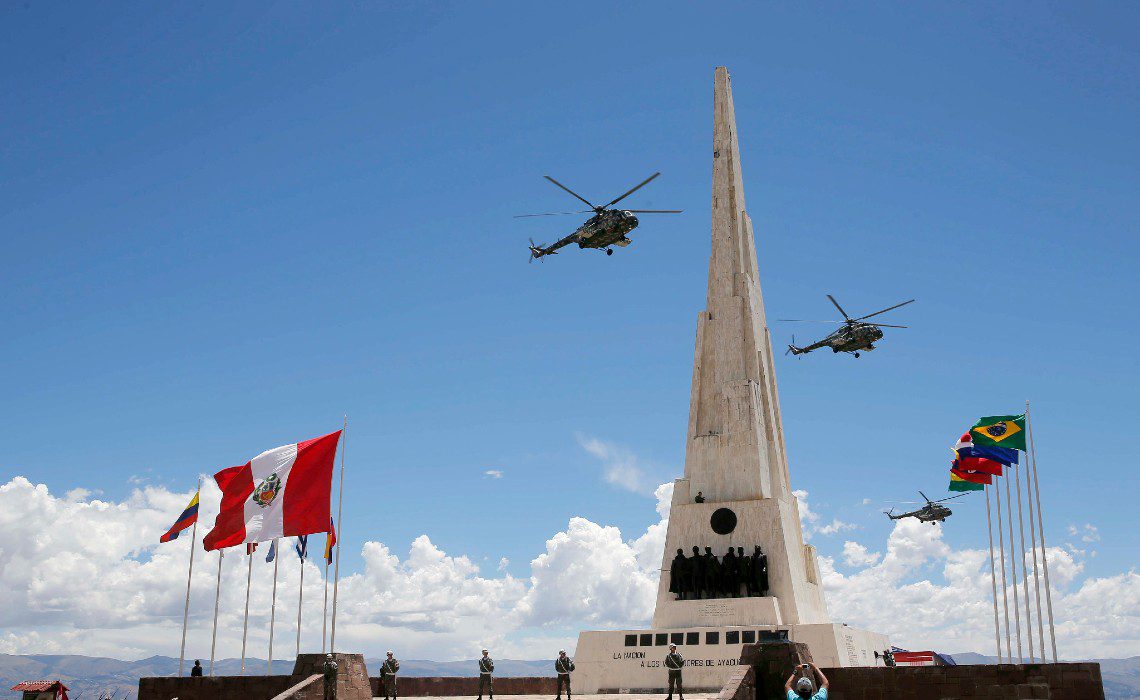
Simón Bolivar and Antonio José de Sucre march into the Peruvian Andes to fight the 2 most important battles of Peru’s independence.
In our 1st episode, we briefly traced General José de San Martín’s long and arduous struggle to liberate Chile and use it as a launching point into Peru, the seat of Spanish power in the New World.
Peru was the seat of power for the Spaniards.
The 2nd part of the series showed how San Martín managed to proclaim Peru’s independence and lay basic foundations for a new state, but he could not establish an effective government or finish off the Spanish loyalists.
It is here that the great general -often made out to be the face of Peruvian independence- resigned his command to Simón Bolivar of the northern revolutionary army and exited the stage long before the job was done.
Who was Simón Bolivar?
Born in Caracas, Venezuela, Simón Bolivar became known as the liberator in the northern part of South America during the wars of independence. They were terribly long, bloody, and brutal wars that liberated Venezuela, Colombia, and Ecuador.
As admirers of Bolivar like to put it, “Washington crossed the Deleware on Christmas day. Bolivar crossed the Andes in midwinter.”
Bolivar also counted on generous support from England in the cause against the Spanish loyalists and recruited local militias of slaves of African and indigenous origin with promises of freedom.
The year was 1823 when Bolivar arrived with his armies.
He had now consolidated command of the entire revolutionary forces of South America. The northern territories were totally liberated. The Spanish empire was unable to send aid because of English and revolutionary navies blocking any access to the west coast of South America. Peru had become the last bastion of the Spanish in the New World. Wasting no time, Bolivar saw to it that the Peruvian congress was established in Lima. Congress promptly named him dictator of Peru in addition to his title of President of Gran Colombia (the united territory of modern day Venezuela, Colombia, and Ecuador).
The Battle of Junín – August 6, 1824
Spanish loyalist forces were far from defeated. They numbered at least 20,000 strong but were divided into 2 armies. In 1824, Bolivar marched into the Peruvian highlands with an army of 9,000 soldiers and managed to catch the smaller enemy force of only 6,000 under general José de Canterac by surprise near Lake Junín.
It is said by some that no shots were fired.
The battle was fought principally with swords and lances wielded by Argentine and English cavalry that chased down De Canterac’s army as he attempted to retreat from the revolutionary forces which outnumbered him. With 500 soldiers lost, the defeat was relatively small in material terms.
However, the skirmish had demoralized the Spanish loyalist forces dramatically and as many as 3,000 of their soldiers were lost “due to desertion, illness, or defection” during their retreat back to Cusco.
The Battle of Ayacucho – December 9th, 1824
After the victory at Junín, Simón Bolivar placed command of the army in the hands of his most trusted general, Antonio José de Sucre. Sucre had already won a number of important battles for the revolutionary forces during the northern campaigns in Gran Colombia.
Whatever kind of person he was, Sucre was undoubtedly a great military tactician. He engaged a larger Spanish loyalist force that outnumbered him 9,000 to 6,000 and equipped with 10 times his artillery.
Sucre understood how he could use the terrain to win despite the apparent disadvantage.
The Loyalists tried to charge in quickly to break out into the open plain where their numbers and artillery would easily overwhelm the independence forces. Sucre foresaw this and positioned his cavalry in the center ready to respond quickly to an attack from any direction on his forces.
The moment the Loyalists made to attack Sucre’s left flank, they were immediately met by a cavalry charge that drove them back and prevented them from gaining this tactical advantage. Another group of heavy cavalry in reserve was deployed decisively on the other flank and Sucre’s revolutionary army routed the Loyalist forces completely.
The Spanish Viceroy José de la Serna and his generals were taken prisoner. The official terms of surrender were drawn and demanded that all Spanish forces were to be expelled from Peru.
The Battle of Ayacucho would subsequently be known as the final decisive victory, not only for Peru’s independence but for the independence of all former Spanish colonies in South America.
However, history does not stop with great military victories. Nor did Spanish forces immediately leave Peru as the terms of surrender dictated. What about the promises to the slaves and lower classes who fought for the revolutionary cause? What of Simón Bolivar’s grand ambitions?
Join us tomorrow for the final episode in Peru’s War of Independence series as we return to Lima for these answers.
Photo: Flickr.

