
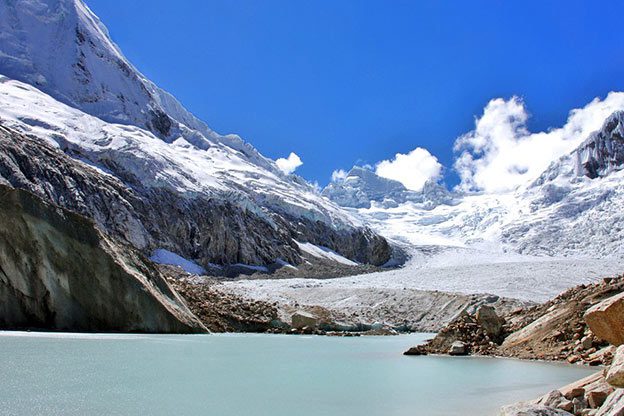
The University of Plymouth and the Geophysical Institute of Peru are carrying out a project to establish the precise effects that future climate changes will cause in the Peruvian Andes, more specifically on its glaciers.
“Remote communities in the Peruvian Andes, as well as communities downstream, depend on the water from melting glaciers and mountain ecosystems to provide them with food and power, and to support industry”, EurekAlert! wrote.
The research project, funded by the United Kingdom through the Newton Fund, awarded by the Natural Environment Research Council (NERC), and Peru’s CONCYTEC, the National Council of Science, Technology and Technological Innovation, is also evaluating how agencies and communities can work together to mitigate the potential effects of changing water quantity and quality as the glaciers melt.
Its key objectives, according to EurekAlert! are: “Identifying the dynamic role of glacial melt in the basin water budget, building upon existing glacier and hydrological monitoring networks in the Cordillera Blanca and remote sensing data; Developing a conceptual model determining the links between upstream pressures and downstream responses through identification of sources of water, sediment and contaminants from both glacier and non-glacier-fed areas; Evaluating the downstream impact of variability in water and sediment supply on contaminant levels and environmental quality; Establishing local capacities to mitigate supply challenges through co-design of a Payment for Ecosystem Services (PES) model, designing a response to a long-term trend of decreased water availability and increased (competing) demands on resources”.


