

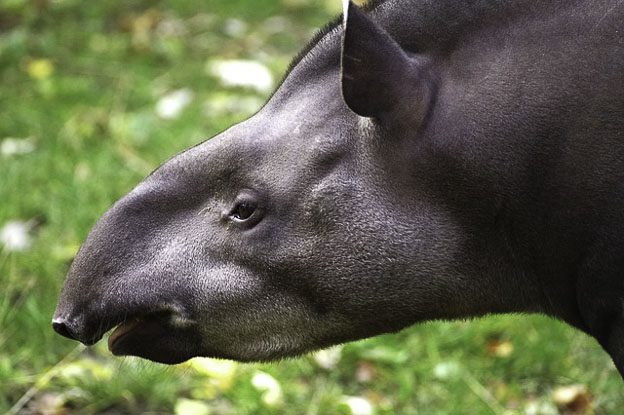
This large animal, commonly referred to as the sachavaca, the wild cow, roams in isolated jungle regions. Due to overhunting, their populations are quickly shrinking within Peru.
Scientific name: Tapirus terrestris
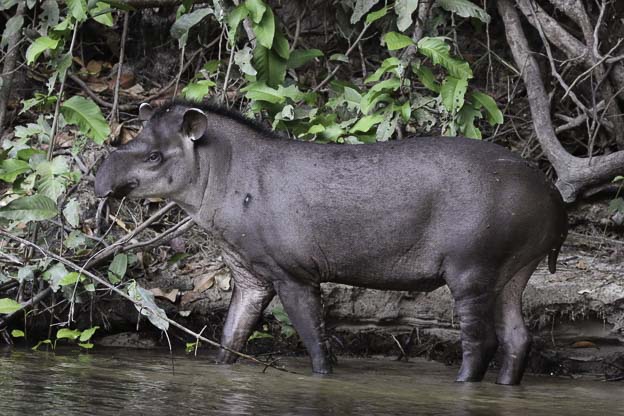
Characteristics of the tapir
Tapirs are the Amazon region’s largest terrestrial vertebrates. Related to horses and rhinos, these large herbivores have robust and rounded bodies, measuring about two meters from the tip of the snout to the rump, and weigh up to 320 kilos. They have thick and powerful necks and their heads are curved into a downwards sloping trunk, which gives its peculiar and recognizable appearance. Its elongated and prehensile snout is very mobile and sensitive, helping them to grasp and tear away at bunches grass with astonishing ease. They can also turn their snouts from one side to the other with a radius of about 30 centimeters without moving the rest of their heads. Their color is a mix between black and brown, which allows them to go unnoticed among the forest’s dense vegetation.
Natural History
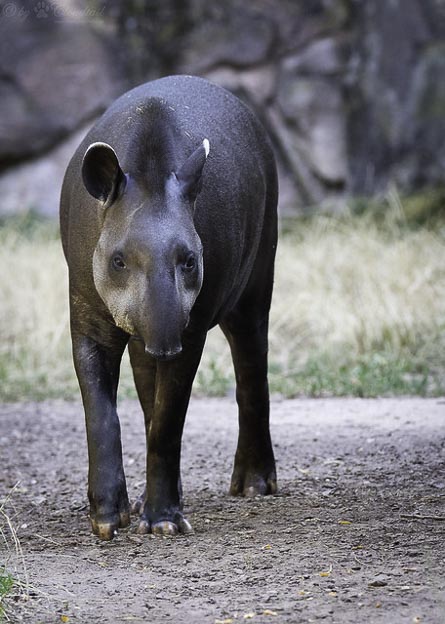
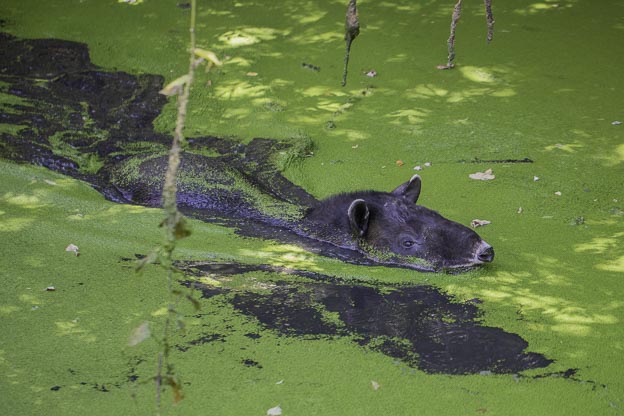
Tapirs are mostly nocturnal. They inhabit the riverbanks and flooded forests of the Amazon. The tapir is a great walker and an excellent swimmer and diver and is able to wade great rivers without apparent difficulty. They have poor sight, but their hearing and smell are extraordinary. They are mostly solitary animals, usually congregating only during the dry season when they feed on outcrops of salt and minerals (essential provisions in their vegetarian diets). Unlike cows, which have stomachs divided into four sections, tapirs have a simple stomach, which has a special chamber where microorganisms live and ‘work’. They eat mainly herbs, fruits, and leaves.
Current status
They are abundant in virgin forests or in places free of human activity. It is a favorite target for hunters and is therefore quickly disappearing from populated areas.
Distribution and range
The tapir can be found in tropical forests from northern Colombia to northern Argentina.
Cover photo: Pixabay
Source: Guia de Identificacion de Especies de la Flora y la Fauna del Peru


