
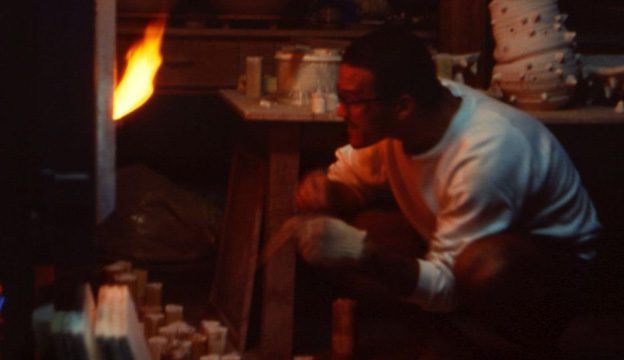
This accomplished artist’s work is on exhibition until June 30 at the Amano Pre-Columbian Textile Museum, in Miraflores, as part of the activities to honor 120 years of Japanese immigration.
The link between man and fire has been strong since the dawn of humanity. Mans ability to use fire has brought forth evolution of how we live, feed ourselves, and stay warm, but the question that really matters is: are we really the dominators of fire? One person seeking the answer to this question is ceramist Carlos Runcie Tanaka, whose exhibition “Fire does not make concessions” is on display until June 30th at the Amano Pre-Columbian Textile Museum in Miraflores. The exhibition is part of the activities to honor 120 years of Japanese Immigration to Peru.
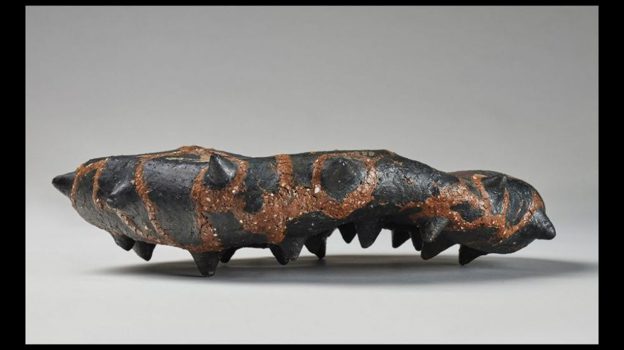
The artist has assembled a selection of pieces crafted by fire, which he has sought to link with Chancay pieces that are already part of the museum’s collection and that were also known as “cooking failures.”
“I decided to undertake a work having to do with transforming fire more than with the study or the aesthetic launch for a visual artist. I believe that the objects I’ve presented are testaments to the strength of fire, of the ceramist’s trials and tribulations, the longing, and effort. It is the ceramist who works every day trying to achieve special effects and to dominate the material, to make it docile for working with, without leaving behind deformations, and that’s why we have a very specific procedure for cooking the pottery, “says Runcie.
He believes that “the technique and the science of this trade are important but there is something that is much more important in order to bring a work of art into completion.”
To be carried away by the fire
The ceramist, trained in Brazil, Italy, and Japan, says that some of these pieces were born in the process of experimentation and dialogue with fire. “I let myself be carried away by it,” he says, while explaining that he allows the kiln to finish the process he has started. This vision which may seem “fatalistic” was influenced by his initial studies in Philosophy at the PUCP. “Destiny is (…) the eternal cause of things by virtue of which they became facts of the past, are facts of the present and will be those of the future.”
Says Runcie: “The ceramicist learns this trade day by day: how to handle the materials and how to control the cooking. It is not always possible to achieve what is desired, often we make mistakes, we must learn how to prepare the materials, how to control temperature, and we must know how to change our plans and overcome the material’s resistance; then, it collapses and deforms. Sometimes the deformation of the pieces is subtle, not foreseen, and at other times there is an expectation – developed through experience- to re-see the ‘accident’ as a result of the cooking process. There is always amazement and the surprise of the final result that does not depend only on the will of the ceramist, but of many agents that intervene in the process and, above all, the transformative power of fire that does not make concessions.”
The artist accepts, from his influences in the East, the cruelty of nature to transform the pieces and give them a “non-symmetrical” perfection (as we conceive it in the West) assuming the “imperfections” as virtues to advance knowledge. Only those who make mistakes and live the process are able to continue advancing in the learning process.
“In some Eastern cultures and in countries such as Japan, these errors are precisely respected as part of the natural process of work – and life – and defective parts acquire a special aesthetic dimension”.
The aesthetics of amazement
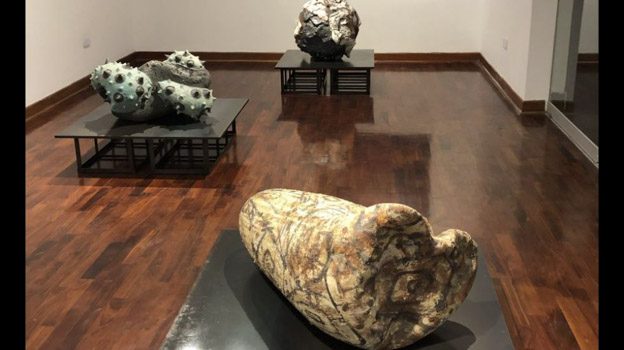
“The amazement, that as a 21st-century man produces the unexpected beauty of the pieces called cooking failures, I entered into the preparation process that has been enriched by the speculative reflection on meanings and relationships between my work and pre-Columbian objects arranged in the room, ” reflects Runcie.
“For this reason I feel that this exhibition is a tribute to the trade of ceramics and the power of transforming fire, to the anonymous ceramicists of pre-Hispanic Peru in the Chancay Culture and to Yoshitaro Amano (founder of the Amano Museum), who interweaved their identity with the Andean millenary culture, and he bequeathed us his wisdom along with his collection of objects, which he treasured until the end of his life .”
The interesting thing is the factor that unites all these works (contemporary and pre-Hispanic), which is undoubtedly the transforming action of fire that (many times) does not make concessions. This causes us great astonishment and the objects are of special beauty, have an intense character and seal a very special moment in the process of working with ceramics.
Editor’s note: This article previously appeared in Spanish on El Comercio, and you can read it here.
Translated from Spanish by Scott Montgomery
Cover photo: El Comercio
YOU MIGHT ALSO LIKE

