
Exodus of thousands of families, abandoned Amazonian communities and unprotected Andean farmers. These are some of the populations in Peru that haven’t received adequate support from regional and central governments.
On April 13, 2020, news broke out of groups of families walking along the central highway leaving Lima and defying the restrictions set in place during the state of emergency. It may seem rebellious, but these walkers are in fact part of a larger group of thousands of families (the government announced that more than 160,000 Peruvians are in this situation) who, because of quarantine, have found themselves without work, money and food. To return to their towns of origin—by foot, no less—is an act based not so much on choice but on it being the only option.
Without the option of regional transportation nor a coordinated effort by central and regional governments to safely transport families, an internal exodus began, with groups as large as 500 people walking together with police escorting them and news cameras filming.
While the state of emergency has put a strain on the entire population, certain groups have found themselves neglected by the actions and inactions taken by the state.
Returning home
“We’ve been abandoned,” was the cry from the group, which included children and elderly persons, many of whom had survived more than a month in Lima in lodgings. Taking matters into their own hands instigated the response from regional governors and other authorities to help displaced residents get home safely.
After many travelers were intervened after three or four days of traveling, the governors of Huancavelica and Junín responded with transportation and spaces in each district for travelers to quarantine, guarded by police and army. Similarly, 40 people traveling for four days were intervened in Ica and transported to their final destination with the coordination of the governor of Ica and Apurímac.
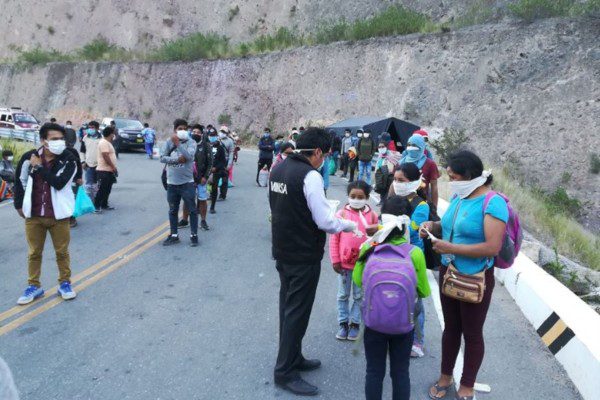
Another scene includes residents of Piura waiting in long lines outside transportation companies in Lima, waiting for as many as three days. Since April 19, the governor of the northern city has authorized humanitarian trips, the first with 200 people in six buses. In most cases, travelers have been provided with the rapid Coronavirus test in order to identify those infected before their arrival.
Amazonian communities
Numerous communities of the Amazon have denounced the lack of adequate support by the government that takes into account their social, cultural and linguistic context. In Madre de Dios, four communities part of the Matsigenka/Matsiguenka peoples have mobilized to ask for protection and emergency support.
Joining them are other national organizations, including anthropologists at the Pontifical Catholic University of Peru. The group calls for urgent steps to support these communities who lack food and adequate medical infrastructure and personnel. They have aligned with the Interethnic Association for the Development of the Peruvian Rainforest (Aidesep), who have also denounced regional and central governments to the UN for inadequate plans to protect Amazonian communities.
In addition to the worry of contagion, the organized communities denounce the lack of solutions for the education of children in remote areas of the country. Education is the most important vehicle for the development of the population, states FENAMAD, the regional organization that represents 37 communities in the department of Madre de Dios.
While there were already shortcomings in the education provided to these communities, remote schooling is impossible for those without electricity, television, internet or radio. And, because Madre de Dios is not considered a region of extreme poverty, the children will not receive the tablets for virtual classes ordered by the government.
Rural producers
The first two direct payments of S/ 380 to citizens (designated for households in condition of poverty or extreme poverty, and independent workers) did not reach the vulnerable population of Andean farmers, who were left without channels to sell their produce with either high costs of transportation or no way to transport their goods during the state of emergency. Around 10 million Peruvians depend on agriculture. Along with the losses they are currently experiencing, many agricultural families do not have access to investments to start up or expand their productive capacity in the future.
More than a month after the state of emergency was enacted did the government respond with a payment specifically for the rural population, including farmers and other day laborers who work in the industry. A payment of S/ 760 reaching more than one million became available on April 27.
Lack of water to support crops is also a serious problem that can have ripple effects with future harvests and growth in the industry. To mitigate, S/ 150 million was transferred to the ministry of agriculture who will use it to maintain 18,950 km of irrigation channels in good conditions in 21 departments across the country.
Cover photo: Geraint Rowland/Flickr

